Murchison Falls National Park is Uganda’s largest and oldest park, located in the country’s northwestern region. It was founded by John Speke and James Grant, the first Europeans to discover the present-day Murchison Falls Conservation Area in 1862. Before being dubbed Kabalega National Park, Sir Samuel and his wife Florence explored there in early 1863-4, and the park was later named by Baker after geologist Roderick and became Murchison Falls National Park.
Sleeping sickness, transmitted by Tsetse flies, decimated the park’s 130000-square-kilometer territory between 1907 and early 1912. In 1926, it was gazetted as a game reserve, and it has since become the largest and oldest conservation area, home to 451 bird species and 76 animal species.
The British Administrator described the park in 952 as Murchison Falls National Park, with limits to the north and south. The park is located in Uganda’s northwestern region, 305 km away by road and a three-hour journey from the capital, Kampala. It is surrounded by various Ugandan districts, including Masindi, Mwoyo, Bulisa, Gulu, Kiryandongo, and many more.
Murchison Falls National Park is encircled by Victoria Nile waters from east to west for approximately 115 kilometres squared, and flows through a tight 7-meter (23-foot) distance before widening to 43 meters (141 feet) at Karuma Falls. The park is also infinite, with banks of the Albert Nile, and its land area is approximately 3893 kilometres squared.
Murchison Falls National Park is a game reserve and forest reserve in the world, home to 450 bird species, 76 animal species, 449 tree species, 29 reptile species, and 49 amphibian species. The park has been managed by the Uganda Wildlife Authority since 1952.
The park is a wildlife sanctuary where visitors can see giraffes, waterbucks, worthgos, Uganda kobs, elephants, lions, buffalos, leopards, Jacksonhert beasts, birds such as Abidin stock, crested crane, Activestock, long crested eagle, cattle egrets, and many more. Murchison Falls National Park features bodies of water where tourists can see water animals such as hippos, Nile crocodiles, water birds such as spurwing birds, Egyptians, Galiaths, and many others, as well as enjoy the splashing waves.
Murchison Falls National Park is also a gazetted forest reserve with around 825 square kilometers of land, which includes fig trees, mahogany trees, Estonia Bonei trees, funtumia elastica trees, and many others.
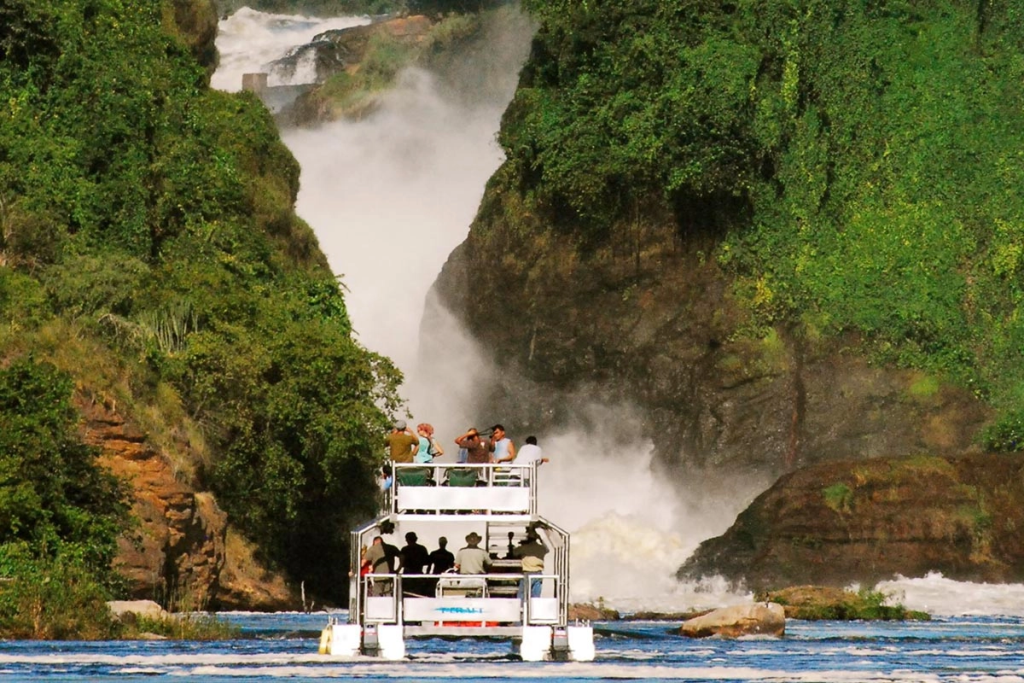
The park is divided by the Victoria Nile, which plunges 45 meters over the surviving rift valley wall, forming the spectacular Murchison falls. The culminating event in an 80-kilometer length of rapids that changes it into another stream that travels across the rift valley floor into Lake Albert. Because it lies inland, the Nile squeezes through an 8-meter-wide opening and plunges with a loud boom into the “Devil’s Cauldron,” creating the famous rainbow.
The park has six gates, including Mubako entrance, Chobe Gate, Bugugu Gate, Tangi Gate, Kichumbanyombo Gate, and Wangkwar Gate, and each entrance charges the same fee: foreigners pay 40 USD, foreigner residents pay 30 USD, and East Africans pay 20000 shillings.
Tourists can go on a three-hour boat cruise, and other private boats can be hired for an additional fee. They will be able to see water animals such as hippos, a number of crocodiles, river banks with spurwing, Egyptian, Galiath, saddle-billed stork, kingfishers, and many more. Visitors can have a good view of splashing waters on the Nile’s top.
Game drive
Murchison Falls National Park is a game drive area with 3893 kilometres squared of land, half of which is reserved for wild animals such as elephants, lions, giraffes, Uganda kobs, waterbuck, and Jackson hurt beast. Visitors can also see over 450 different types of birds such as cattle egrets, active stock, crested crane, long crested eagle, Abidin stock, blue headed coucal, and many more. It can be done in the morning, afternoon, and sometimes at night, as directed by the guide.
Nature Walk
The guided nature walk at Murchison Fall takes two to four hours and includes a variety of tree species such as fig trees, mahogany trees, Albania trees, Alstonia Boonei, velvet monkeys, white and Columbus moneys, green bulls, sunbirds, Danvers, horn bills, shoebills and many other bird species.
Community Visits
Murchison Falls is surrounded by a number of tribes, including the Alur, Acholi, and Banyoro people. Tourists can experience the original African culture by visiting this tribe and learning about their unusual way of life. They can also buy locally manufactured crafts made from local resources and take them with them as a souvenirs.
Chimpanzee Trekking
The guided chimp trekking, which can last two to three hours in the Budongo forest, allows guests to see a variety of tree species as well as over 450 birds.
Sport Fishing
Murchison Falls offers a sport fishing experience that is best enjoyed between December and March, and June and October. Visitors are encouraged to go fishing with an experienced tourist guide, regardless of how excellent they are at fishing.
Murchison Falls National Park offers a variety of accommodation choices for tourists, including Paraa Safari Lodge, Budongo Eco Lodge, Sambiya Safari Lodge, Chobe Safari Lodge, Red Chill Lodge, and many others, depending on their budget.
Murchison Falls National Park is well-known in East Africa and around the world for its famous activities, which are best enjoyed by tourists during the dry seasons of March, June, October and December. A safari to Murchison is worth the time.