A Guide to the Great Wildebeest Migration : Witnessing the Great Wildebeest Migration in Tanzania is an exciting experience that everyone will look forward to. The Great Wildebeest Migration, a year-round natural wonder and one of the most stunning sights on Earth, is a must-see for tourists. But did you know that all of this happens in specific regions and during specified months? Because the Serengeti is so vast, seeing the World Wonder requires knowledge of the migrating herds’ locations. Fortunately for you, here’s an overview showing where to go and when:
January – February
The herds prefer the southern Serengeti’s short grass plains, the Ndutu region, and the northern half of the Ngorongoro Conservation Area. By the end of January, the calving season has begun, and the mother hooves are prepared to give birth. During this season, nearly 8,000 young wildebeests are born per day. Prepare to be amazed when these newborn hooves first appear in the world and start running on their weak legs.
Predators are, of course, constantly seeking for prey. Hungry predators plan a violent attack while mature wildebeests protect their young, defenceless mothers. Throughout the months, there will be lots of action and drama to watch.
March
The final groups of calves are giving birth, and the hooves are preparing to move north. Expect the herds to spread throughout the southern Serengeti plains, feeding on the last grasses. Rain may potentially begin in late March.
April & May
In Tanzania, April and May are considered the wettest months of year. Expect lush, gorgeous flora as a result of the extended rain. During these months, wildebeest herds can be seen in the area surrounding Central Seronera. Many zebras and gazelles join the herds as they cross the terrain and rivers on their way north to the western region.
June
The identifiable river crossings begin in June. Herds can be spotted throughout the Western Corridor. When they reach the south bank of the Grumeti River, they create a pile to navigate the numerous channels and pools. The Grumeti River is shallow and does not flow continuously thus there is some activity while Nile crocodiles wait to pounce. However, this event is simply a “practice” for the hooves, as they are aware that what is about to happen further north will be their greatest accomplishment to date.
July – September
These are the months when the frequently bloody Mara River crossing occurs. Millions of wildebeests, as well as thousands of zebras, gazelles, and kudus, struggle to survive as they run across the predator-infested Mara River to join the Masai Mara National Reserve. This incredible spectacle is known as the “World Cup of Wildlife” and frequently lasts into October.
October
Many migrating hooves perish while crossing the river because to exhaustion, starvation, or predators. Survivors in Masai Mara National Reserve feast on young grasses to honour their success. Other ungulates that have remained in the Serengeti region graze on the northern Serengeti’s grasslands. The migratory herds return to the southern Serengeti National Park around the end of October, after the brief rainy season has provided a plenty of water, to seek for food.
November
The majority of the Mara’s remaining herds start their southward migration, passing via western Loliondo and the Lobo section of Serengeti National Park.
December
The herds cluster in the southern and northeastern Serengeti areas, where they graze on lush meadows. The wildebeests are aware that the calving season is approaching, and the migration cycle will resume at this time.
Why is the Great Migration so fascinating?
The Great Migration, also known as the Serengeti Migration or the Wildebeest Migration, is the world’s greatest inland animal migration. Thousands of zebras, Thomson’s gazelles, impalas, kudus, and over two million wildebeests smash over the Serengeti National Park habitat in this amazing display of wildlife movement. Predators such as lions, hyenas, leopards, cheetahs, and others are stalking the moving herds in the hopes of catching a meal. The waters are home to massive Nile crocodiles and highly territorial hippos.
Having this experience even once in your life is like witnessing one of nature’s most incredible events. The action, drama, and amazement come together to create an unforgettable Tanzania safari experience. Additionally, this experience is unique to this area.
How It Happens
Serengeti National Park:
Beginning in January, migrating hooves go clockwise over the Serengeti National Park plains. Between July and October, herds begin crossing the Mara River in search of feeds in the adjacent Masai Mara National Reserve. When the rains come in November, they return to the Serengeti National Park.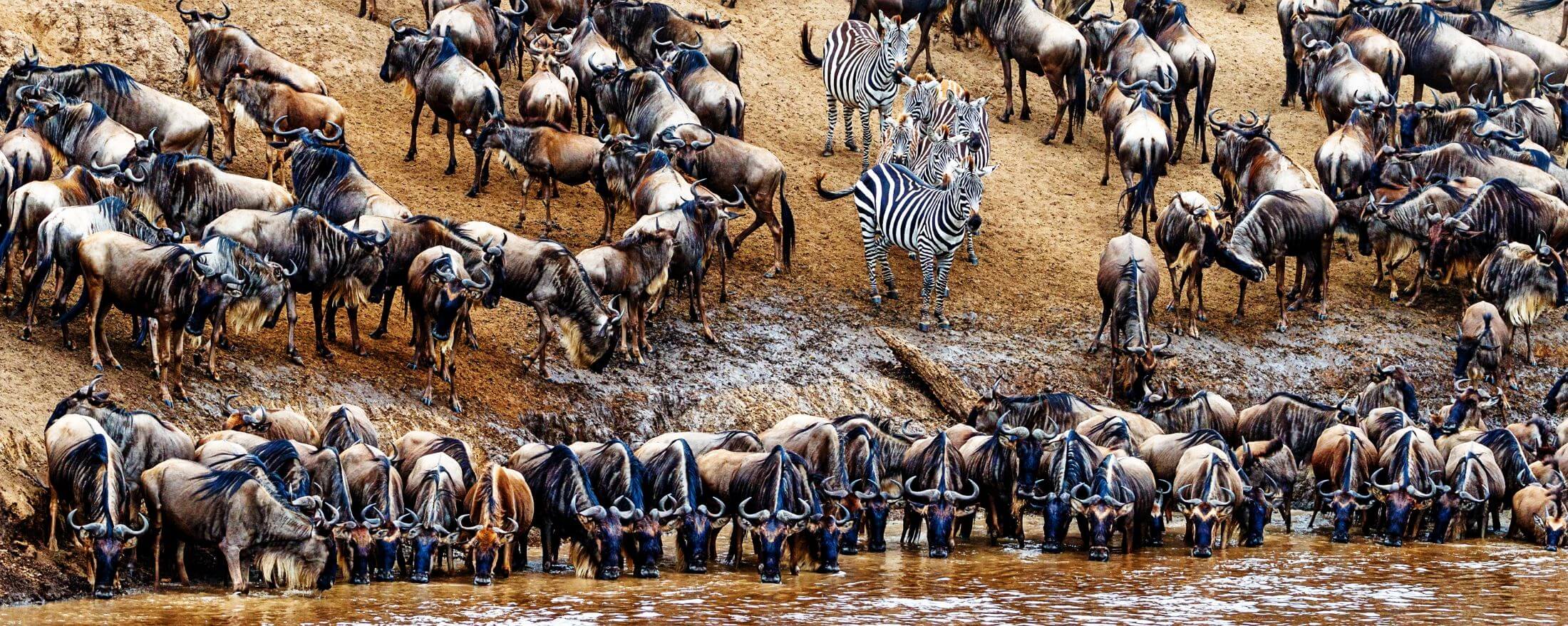
Masai Mara National Reserve.
From July to October, migratory hooves appear in Masai Mara National Reserve. They graze on the fresh grasses of the Serengeti National Park until November, when they return there.
The Great Migration, one of the most sought-after wildlife and nature experiences, involves the continuous movement of nearly a million animals clockwise across the Serengeti-Mara habitat. Columns of wildebeest, joined by a variety of friends, travel an old route in search of water and grazing grounds. Following their calving in the southern Tanzanian Serengeti near the Ngorongoro Conservation Area, the animals move across the Serengeti up and around to the Masai Mara in Kenya, returning towards the end of the year. The trip is always loaded with drama, as predators kill thousands of animals while thousands more are born, restoring numbers and perpetuating the circle of life.