Machame Route: The Whiskey Route to Kilimanjaro’s Summit
Machame is often called the “Whiskey Route,” a nickname that contrasts it with the gentler Marangu “Coca-Cola Route.” It suggests a tougher, more adventurous climb, and that reputation is partly deserved. Machame involves camping, steeper sections and long days. Yet with a seven-day itinerary and good pacing, it offers an excellent acclimatisation profile and one of the best combinations of scenery, success and value on the mountain.
Plan a Machame Route climb on Kilimanjaro. Day-by-day itinerary, camps and altitudes, the Barranco Wall, 6-day vs 7-day options, success rates, costs, crowds, best season and expert tips.
This guide explains the Machame Route day by day, compares six- and seven-day versions, and covers difficulty, crowds, costs, seasons and how to give yourself the best chance of reaching the summit.
Machame Route at a Glance
| Feature | Details |
| Start | Machame Gate, about 1,800 m |
| Finish | Mweka Gate, about 1,630 m |
| Duration | 6 or 7 days |
| Distance | About 62 km |
| Accommodation | Tents |
| Summit approach | Barafu Camp to Stella Point and Uhuru Peak |
| Highlights | Shira Plateau, Lava Tower, Barranco Wall |
| Crowds | Busy in peak season |
Machame Route Itinerary: 7 Days
| Day | Route | Altitude | Distance | Time |
| 1 | Machame Gate to Machame Camp | 1,800 to 2,835 m | About 11 km | 5 to 7 hours |
| 2 | Machame Camp to Shira Camp | 2,835 to 3,850 m | About 5 km | 4 to 6 hours |
| 3 | Shira Camp to Lava Tower to Barranco Camp | 3,850 to 4,630 to 3,960 m | About 10 km | 6 to 8 hours |
| 4 | Barranco Camp to Karanga Camp | 3,960 to 3,995 m | About 5 km | 4 to 5 hours |
| 5 | Karanga Camp to Barafu Camp | 3,995 to 4,673 m | About 4 km | 3 to 4 hours |
| 6 | Barafu Camp to Uhuru Peak to Mweka Camp | 4,673 to 5,895 to 3,100 m | About 17 km | 12 to 16 hours |
| 7 | Mweka Camp to Mweka Gate | 3,100 to 1,630 m | About 10 km | 3 to 4 hours |
Day 1: Machame Gate to Machame Camp
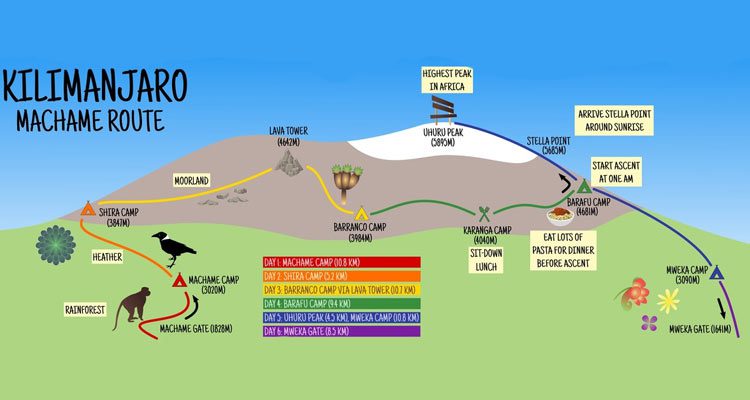
After registration at Machame Gate, you walk through dense montane rainforest on a well-worn trail. The forest is humid and often misty, with giant trees, ferns and moss. Colobus monkeys may be seen. The climb is steady, and you arrive at Machame Camp at the edge of the forest in the afternoon.
Day 2: Machame Camp to Shira Camp
The trail leaves the forest and climbs through heath and moorland, with giant heathers and rocky ridges. You reach the Shira Plateau, a vast volcanic plateau with views of Kibo ahead and, on clear days, Mount Meru to the west.
Day 3: Shira Camp to Lava Tower to Barranco Camp
This is a key acclimatisation day. You climb to Lava Tower, a dramatic volcanic rock formation at about 4,630 metres, then descend to Barranco Camp at about 3,960 metres. This “climb high, sleep low” day helps your body adapt to altitude. Barranco Camp sits beneath the Barranco Wall and the glaciers of Kibo.
Day 4: Barranco Camp to Karanga Camp
The day begins with the Barranco Wall, a steep rock face of about 250 metres. It looks intimidating, but it is a non-technical scramble using hands for balance. Guides help climbers through tricky sections. After the wall, the trail crosses valleys to Karanga Camp, offering spectacular views of the summit.
Day 5: Karanga Camp to Barafu Camp
A shorter day brings you to Barafu Camp, the high camp at about 4,673 metres. The landscape is rocky and barren. You arrive early, rest, eat and prepare for summit night.
Day 6: Summit night and descent
You wake around 11:00 p.m. and begin climbing at midnight. The route climbs steep scree and switchbacks to Stella Point on the crater rim, usually reached around dawn. From there, it is about an hour along the rim to Uhuru Peak. After photographs, you descend to Barafu for a rest, then continue to Mweka Camp.
Day 7: Mweka Camp to Mweka Gate
The final descent passes through rainforest to Mweka Gate, where you receive your summit certificate and celebrate with your crew.
Machame Route: 6 Days vs 7 Days
| Factor | 6 days | 7 days |
| Acclimatisation | Rushed | Better |
| Success rate | Lower | Higher |
| Cost | Lower | Higher |
| Rest at Karanga | No | Yes |
| Recommended for | Acclimatised or experienced climbers | Most climbers |
The seven-day version adds a night at Karanga, breaking the long walk from Barranco to Barafu and improving acclimatisation. For most climbers, the extra day is worth it.
Why It’s Called the Whiskey Route
Machame earned its nickname because it is more demanding than Marangu, the “Coca-Cola Route,” which used to offer soft drinks at its huts. Machame involves camping, steeper sections and longer days. Today, both routes are well established, but the nicknames remain a way to describe their character.
The Barranco Wall
The Barranco Wall is one of the most famous sections of Kilimanjaro. It looks steep from Barranco Camp, and many climbers feel nervous. In reality, it is a well-used scramble with a clear path. You use your hands at times, and there are a few exposed steps, but no technical climbing skills are needed. Guides and porters help climbers, and the view from the top is spectacular.
Crowds on the Machame Route
Machame is Kilimanjaro’s most popular route, and camps can be busy in peak months such as July, August and late December. Queues may form at the Barranco Wall in the mornings. Choosing shoulder months or starting early can help.
Success Rates
Seven-day Machame climbs generally have good success rates thanks to the Lava Tower acclimatisation day and the extra night at Karanga. Six-day versions are lower. Operator quality, pacing and individual responses to altitude also affect success.
Costs
| Item | Approx. cost |
| Park fees for 7 days | Around US$1,000 or more, including VAT |
| Mid-range 7-day package | US$2,500 to 4,000 per person |
| Premium package | US$4,000 and above |
| Tips | US$250 to 400 per climber |
Best Time to Climb the Machame Route
| Months | Conditions |
| January to early March | Dry, clear, moderate crowds |
| June to October | Dry, colder, busiest |
| April to May | Long rains, muddy southern slopes |
| November | Short rains |
| December | Good, busy at holidays |
Machame’s southern slopes receive more rain than the northern routes, so the dry seasons are particularly recommended.
Machame Compared With Lemosho
| Factor | Machame | Lemosho |
| Start | Southern forest | Remote western forest |
| Duration | 6 to 7 days | 7 to 8 days |
| Crowds | Busier | Quieter early days |
| Cost | Lower | Higher |
| Scenery | Excellent | Outstanding |
| Acclimatisation | Good on 7 days | Excellent |
The Shira Plateau and Lava Tower Up Close
The second and third days of the Machame Route are among the most memorable. Emerging from the forest onto the Shira Plateau, you enter a different world: wide skies, giant heathers and views across an ancient caldera formed when Shira, Kilimanjaro’s oldest volcanic cone, collapsed. On clear afternoons, Mount Meru rises on the western horizon, and sunsets over the plateau are spectacular.
The walk to Lava Tower crosses alpine desert, where vegetation thins and the landscape becomes rocky and stark. Lava Tower itself is a 90-metre volcanic plug, a reminder of Kilimanjaro’s fiery past. Many climbers feel the altitude here for the first time, with mild headaches or breathlessness. Descending to Barranco Camp in the afternoon usually brings relief, and the giant senecios of the Barranco Valley create one of the most surreal landscapes on the mountain.
Camp Life on the Machame Route
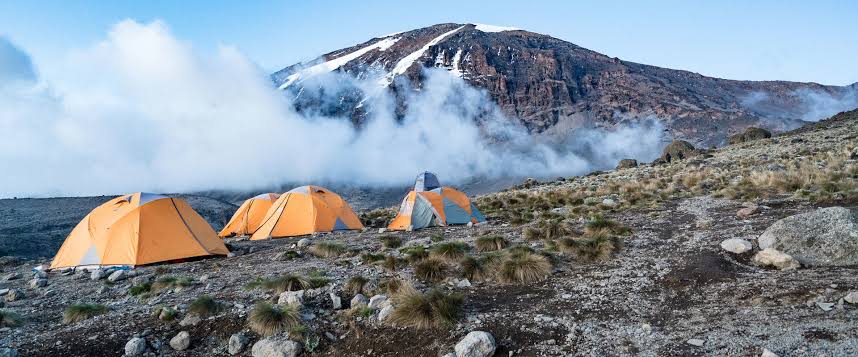
Machame camps are tented, with sleeping tents for climbers, a mess tent for meals and toilet tents provided by most reputable operators. Porters arrive ahead of you and set up camp, so tents are usually ready when you arrive. Meals are hearty and designed to provide energy at altitude. Evenings are cold, especially from Shira Camp onwards, so a warm sleeping bag and layers are essential.
Because Machame is popular, camps can be lively, with climbers from around the world sharing stories. Some climbers enjoy the social atmosphere; others prefer quieter routes.
Managing the Mweka Descent
After summiting, Machame climbers descend via the Mweka Route. The descent from Barafu to Mweka Camp is steep and long, often on loose scree and rocky paths. Trekking poles help protect your knees, and walking slowly reduces the risk of slips. The final day through the rainforest to Mweka Gate is muddy in places but beautiful, with colobus monkeys and lush vegetation. Many climbers find the descent physically harder than expected, so preparation for downhill walking is worthwhile.
Who Should Choose Machame Over Other Routes?
Machame is ideal for climbers who want dramatic scenery, a good acclimatisation profile and value for money. It is a strong choice for fit first-timers with seven days available, for groups who enjoy a social atmosphere and for climbers who want to experience the Barranco Wall. If crowds concern you, Lemosho offers a quieter start, while Rongai and the Northern Circuit offer more solitude throughout.
Expert Perspective
Guides who have climbed Machame hundreds of times often say the route rewards patience. Climbers who walk slowly on the first two days, enjoy the views on the Shira Plateau and take the Lava Tower day calmly tend to feel strongest on summit night. The Barranco Wall, which worries many in advance, usually becomes one of the most enjoyable parts of the climb.
The Machame Gate and Moshi Logistics
Machame Gate lies about 45 minutes to an hour from Moshi, making it one of the most accessible trailheads. Most climbers spend the night before the climb in Moshi or nearby lodges, where operators hold briefings, check gear and arrange rentals. On the morning of the climb, registration at the gate can take an hour or more in peak season while park staff check permits and porters weigh loads. Bringing patience and a good book helps. After the climb, the drive from Mweka Gate back to Moshi is short, so you can enjoy a hot shower and celebration dinner the same evening.
Final Week Before Your Climb
The last week before a Kilimanjaro climb matters more than many people realise. Reduce training intensity so your legs are fresh. Prioritise sleep, eat well and avoid illness by washing hands often while travelling. Arrive in Moshi or Arusha at least a day before the climb, ideally two, to recover from flights and adjust to the climate. Use this time to attend your operator’s briefing, check rental gear, pack your duffel within the weight limit and organise your daypack for the first day. A calm, rested start sets the tone for the whole climb.
Frequently Asked Questions About the Machame Route
How long is the Machame Route?
Six or seven days, covering about 62 kilometres.
Is the Machame Route difficult?
It is moderately difficult, with steep sections and a challenging summit night.
Is the Barranco Wall dangerous?
It is a non-technical scramble. With care and guide support, it is safe for most climbers.
What is the success rate on Machame?
Seven-day climbs generally have good success rates; six-day climbs are lower.
Why is Machame called the Whiskey Route?
Because it is considered tougher than the Marangu “Coca-Cola” Route.
Is Machame crowded?
It can be busy in peak months, particularly at Barranco and Barafu camps.
How many porters will I have?
Typically two to four porters per climber, depending on the operator and group size.