Tanzania Primate Safaris
Ask most travellers what Tanzania offers and you will hear about the Serengeti migration and the Ngorongoro Crater within the first sentence, and rightly so. What rarely comes up is that Tanzania also holds some of the most significant chimpanzee research sites on the planet, an island national park built specifically around reintroduced chimpanzee populations, and forest reserves on Zanzibar home to a monkey species found nowhere else on earth.
Primate tourism in Tanzania is smaller and less developed than Uganda’s or Rwanda’s, which is exactly why it appeals to a specific kind of traveller: one who has already done a standard safari and wants something genuinely less crowded. None of this is widely marketed, which is part of why so few first-time visitors even know these options exist until they start digging past the standard itinerary templates.
This guide covers where Tanzania’s primate experiences actually happen, what makes each one distinctive, what they cost, and how to realistically combine them with a broader Tanzania safari itinerary.
Should You Add Primate Tracking to a Tanzania Trip?
Short answer: yes, if you have flexibility on time and are drawn to genuinely low-crowd wildlife experiences, but go in understanding that Tanzania’s primate sites require more effort to reach than a standard Serengeti circuit stop.
Unlike Uganda, where gorilla and chimpanzee trekking sits conveniently along established safari routes, Tanzania’s best primate sites, Mahale Mountains, Gombe Stream, and Rubondo Island, all sit on or near Lake Tanganyika or Lake Victoria, requiring a dedicated charter flight rather than a simple add-on day.
This is not a reason to skip them, but it is a reason to plan deliberately rather than assume they slot easily into an existing northern circuit itinerary. Guests who treat this as a genuine extension, with its own dedicated days and budget line, tend to come away far happier than those who try to squeeze it into a schedule built primarily around the Serengeti and Ngorongoro.
Why Tanzania’s Primate Sites Are Genuinely Special
Gombe Stream National Park holds a particular claim to scientific fame: it is where Jane Goodall began her pioneering chimpanzee research in 1960, fundamentally changing how science understood primate behavior, tool use, and social structure.
Mahale Mountains National Park, further south along Lake Tanganyika’s shore, protects one of the largest known populations of wild chimpanzees in Africa, estimated at several hundred individuals, within a genuinely remote, boat-access-only setting that feels closer to true wilderness than almost any other primate tourism site on the continent.
Rubondo Island in Lake Victoria takes a different approach entirely: chimpanzees here were deliberately reintroduced from captivity starting in the 1960s, and the island now also hosts other introduced species, including giraffe and elephant, alongside native sitatunga antelope, creating an unusual, human-assisted island ecosystem.
Where Tanzania’s Primate Experiences Happen
| Location | Primate Species | Access |
| Gombe Stream National Park | Chimpanzees | Boat from Kigoma, no road access |
| Mahale Mountains National Park | Chimpanzees | Charter flight to Mahale airstrip, then boat, or boat from Kigoma |
| Rubondo Island National Park | Chimpanzees (reintroduced) | Charter flight or boat from Mwanza |
| Jozani Chwaka Bay National Park, Zanzibar | Zanzibar red colobus monkeys (endemic) | Short drive from Stone Town or East Coast resorts |
| Arusha National Park | Black-and-white colobus monkeys, blue monkeys | Easily combined with a Kilimanjaro or northern circuit itinerary |
Gombe Stream: Where Modern Primatology Began
Gombe is Tanzania’s smallest national park, a narrow strip of forest along Lake Tanganyika’s eastern shore, accessible only by boat from the town of Kigoma. Its habituated chimpanzee community, descended from the same groups Jane Goodall studied over six decades ago, remains one of the longest continuously studied wild primate populations anywhere in the world, giving researchers and, by extension, visiting guides an unusually deep well of behavioral and genealogical knowledge to draw on during a trek.
Practical implication: Gombe’s remoteness means it suits travellers with genuine flexibility and interest in primate research history specifically, rather than those looking for the most convenient add-on to a standard itinerary.
Mahale Mountains: Wild Chimpanzees at Genuine Scale
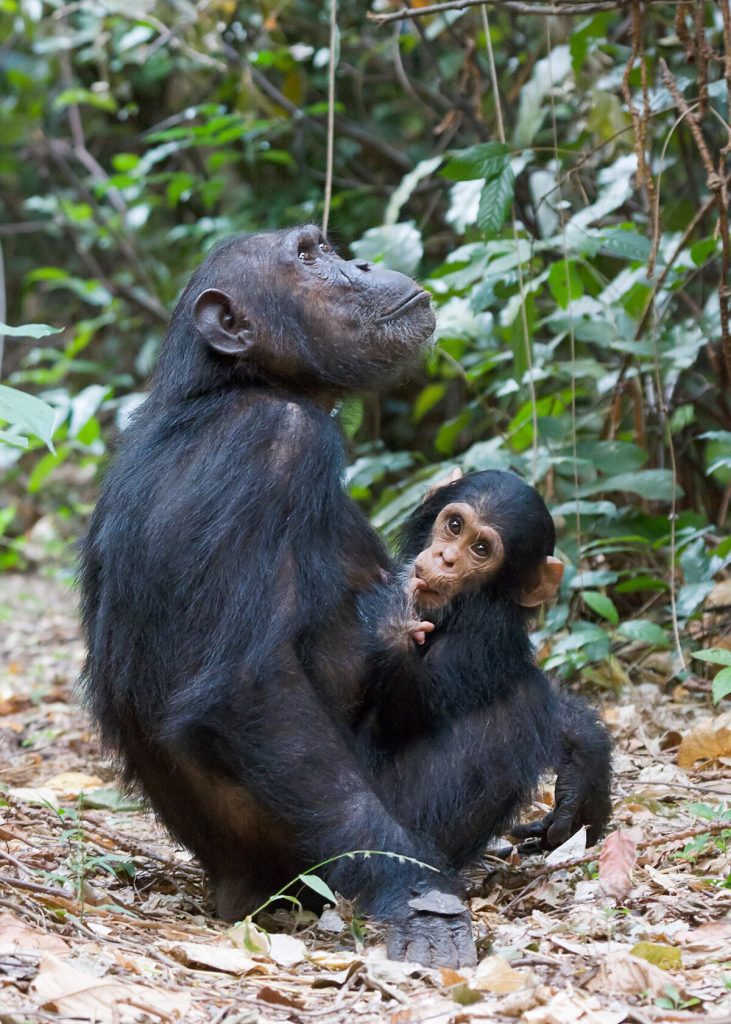
Mahale offers a different flavor of chimpanzee experience from Gombe, larger in scale and set within a genuinely mountainous, forested national park rather than a narrow lakeshore strip. Treks here can involve more serious hiking than Gombe’s shorter, gentler trails, sometimes requiring several hours through dense forest and steep terrain to reach a chimpanzee community, followed by the same one-hour observation window used across East Africa’s primate tourism model.
The setting itself is part of the appeal. Most visitors combine chimpanzee trekking with beach time directly on Lake Tanganyika’s white sand shoreline, an unusual and genuinely restful pairing rarely available at other primate trekking destinations, where accommodation tends toward forest lodges rather than lakeside beach camps.
Rubondo Island: A Different Kind of Primate Story
Rubondo’s chimpanzee population exists because of a deliberate 1960s and 1970s conservation experiment, relocating chimpanzees rescued from captivity in Europe to a protected island setting free of natural predators, allowing the population to establish and grow with minimal direct human interference over subsequent decades. This history means Rubondo’s chimpanzees are, in a strict sense, not native to the island, a detail some conservation purists raise, but the resulting population is now well-established, semi-wild, and genuinely difficult to habituate to close observation, meaning sightings here tend to be more distant and less reliable than at Gombe or Mahale.
Rubondo’s broader appeal extends beyond chimpanzees to birdlife, forest walks, and a genuinely tranquil, little-visited island setting within Lake Victoria, making it a worthwhile stop for travelers seeking variety over a guaranteed close chimpanzee encounter specifically.
Zanzibar’s Red Colobus Monkeys
Jozani Chwaka Bay National Park on Zanzibar protects the Zanzibar red colobus, a monkey species found nowhere else on earth, distinguished by a striking reddish-brown coat and a notably relaxed, low-flight-response temperament around visitors compared with most wild primates.
This is an easy, low-cost half-day activity that combines naturally with a Zanzibar beach stay, requiring no strenuous trekking and offering close, reliable viewing given the habituated troops’ comfort around the park’s walking trails.
Practical implication: this is the most accessible primate experience on this entire list, suited to families, less mobile travellers, or anyone wanting a primate encounter without the cost or physical demand of chimpanzee trekking.
Arusha National Park’s Overlooked Primates
Often used purely as a short pre-Kilimanjaro warm-up game drive, Arusha National Park also holds healthy populations of black-and-white colobus monkeys and blue monkeys, easily seen on a standard game drive without any dedicated trekking permit. This makes it a convenient, no-extra-effort way to see genuine wild primates for travelers whose itinerary already includes an Arusha stop before or after a Kilimanjaro climb or northern circuit safari.
What Tanzania’s Primate Experiences Cost
| Experience | Approximate Cost Per Person | Notes |
| Gombe chimpanzee permit | $100 to $150 | Plus boat transport from Kigoma |
| Mahale chimpanzee permit | $100 to $150 | Plus charter flight or boat transport, a significant additional cost |
| Rubondo Island chimpanzee tracking | $50 to $100 | Plus a charter flight or boat from Mwanza |
| Jozani red colobus visit | $10 to $15 | Low-cost, easily self-arranged from Zanzibar |
| Arusha National Park entry (includes primate viewing) | $45 to $60 | Standard park entry fee, no separate primate permit required |
Combining Primates With a Broader Tanzania Safari
The realistic way to fit Mahale or Gombe into a Tanzania trip is as a dedicated extension rather than a quick stop, given the charter flight time and cost involved. A common, well-paced structure looks like six to seven days across the northern circuit, Serengeti, Ngorongoro, and Tarangire, followed by a charter flight to Mahale or Gombe for three to four days, then either returning home or continuing to Zanzibar for a beach finish.
Rubondo fits more easily alongside a Serengeti-focused itinerary, given its position closer to the northern circuit’s general flight network through Mwanza. Guests with genuinely generous time budgets, two weeks or more, can realistically combine all three elements, northern circuit, a western primate extension, and Zanzibar, though this represents a significant trip in both length and cost rather than a typical first Tanzania visit.
Where You Will Stay
Accommodation at Tanzania’s primate sites is considerably more limited than around the northern safari circuit, a natural consequence of their remoteness and lower visitor volume.
- Mahale Mountains: a small number of tented camps line the lakeshore, ranging from simple, comfortable properties to a handful of genuinely luxury options offering private beachfrontage alongside chimpanzee trekking access.
- Gombe Stream: very limited accommodation directly at the park, with most visitors basing themselves in Kigoma town and taking a day boat trip, or staying at the park’s one small resthouse-style option.
- Rubondo Island: a single main lodge option on the island itself, run in partnership with the park authority, offering the only accommodation directly within the park boundary.
- Jozani, Zanzibar: no accommodation within the park itself; visitors stay at nearby east coast beach resorts and visit as a day activity.
When to Visit Tanzania’s Primate Sites
| Location | Best Months | Notes |
| Mahale Mountains | May to October | Drier conditions improve trekking terrain and access; some camps close during the heaviest rains. |
| Gombe Stream | May to October | Similar dry season advantages, though year-round access is generally possible given the shorter, gentler trails |
| Rubondo Island | June to September, December to February | Aligns with the broader northern circuit’s dry seasons |
| Jozani, Zanzibar | Year-round | Monkey viewing is reliable regardless of season, though the wettest months (April, May) can make trails muddier. |
Who This Type of Trip Suits
| Traveler Type | Fit | Reasoning |
| Repeat Tanzania visitors | Strong fit | Already familiar with the northern circuit and seeking a genuinely different experience |
| Wildlife photographers | Strong fit | Mahale’s setting and lower crowd density offer distinctive, less commonly seen imagery. |
| Families with young children | Better suited to Jozani only | Chimpanzee trekking’s physical demands and long travel times suit older children and adults better. |
| Beach-and-wildlife combination travellers | Strong fit for Mahale | The lakeshore setting genuinely combines chimpanzee trekking with beach relaxation in one location. |
| First-time Tanzania visitors with under 10 days | Poor fit for Mahale or Gombe | Limited time is better spent on the core northern circuit; save primate extensions for a return trip. |
Planning Advice
- Budget for the charter flight, not just the permit. This is consistently where first-time enquirers underestimate the true cost of a Mahale or Gombe extension.
- Choose Mahale over Gombe if scenery and a beach pairing matter to you. Gombe suits travellers specifically drawn to its research history; Mahale offers a more varied, restful overall setting.
- Add Jozani to any Zanzibar stay regardless of your other primate plans. It is inexpensive, low-effort, and delivers a genuinely unique species found nowhere else.
- Book Mahale or Gombe well in advance if travelling in the dry season. Limited accommodation capacity in both locations means availability tightens considerably during peak months.
- Treat Rubondo as a variety stop rather than a guaranteed close chimpanzee encounter. Set expectations accordingly given the less-habituated nature of its population.
Frequently Asked Questions
Is Tanzania chimpanzee trekking as good as Uganda’s?
Mahale in particular offers an outstanding, genuinely wild chimpanzee experience, arguably more dramatic in setting than Uganda’s Kibale Forest, though Uganda’s chimpanzee trekking program is more established, easier to reach, and more affordable overall.
Do I need a special permit for Zanzibar’s red colobus monkeys?
No separate trekking permit is required, just standard Jozani Chwaka Bay National Park entry, making this the simplest and most affordable primate experience covered here.

How long does it take to reach Mahale or Gombe from the northern circuit?
Typically a half-day journey involving a charter flight, sometimes with a connection through Arusha or Kigoma, meaning it functions best as a genuine multi-day extension rather than a rushed add-on.
Can I see gorillas in Tanzania?
No, mountain gorillas exist only in Uganda, Rwanda, and DR Congo. Tanzania’s primate offerings center on chimpanzees and monkey species rather than gorillas.
Is Rubondo Island worth visiting if chimpanzee sightings are not guaranteed?
Yes, for travellers interested in the island’s broader ecosystem, birdlife, and tranquil setting rather than a chimpanzee encounter as the sole objective. If a guaranteed close chimpanzee sighting is your priority, Mahale or Gombe is the stronger choice.
How physically demanding is chimpanzee trekking compared with gorilla trekking?
Broadly comparable, and sometimes more demanding at Mahale specifically, since chimpanzees move faster and range more widely through the forest canopy and undergrowth than gorillas, occasionally requiring a brisker pace to keep up once a group is located.
Can I fly directly to Mahale from outside Tanzania?
No, Mahale is only reachable via a domestic charter connection, typically routed through Arusha, Dar es Salaam, or occasionally Kigoma, after an international arrival elsewhere in Tanzania.
Making Room for Primates in Your Tanzania Trip
Tanzania’s primate experiences will never be as convenient or as heavily marketed as its classic safari circuit, and that is precisely their appeal for travellers who have already done the standard trip and want something genuinely different.
Whether that means Jane Goodall’s original research site at Gombe, the wild scale of Mahale, or a simple, affordable half-day with Zanzibar’s endemic red colobus monkeys, these experiences reward the extra planning effort they require, and they consistently rank among the most memorable days of a trip for the travellers willing to make the detour.