Where To Go For A Honeymoon Safari In Tanzania?
Where To Go For A Honeymoon Safari In Tanzania? A Tanzania honeymoon safari works because of contrast. The days in the bush, waking before dawn to go out into the Serengeti when the light is still the colour of cold ash and the lions are just returning from the night, are some of the most intensely alive days that travel offers.
The days on Zanzibar afterwards, where the pace drops to the rhythm of the tide and the only decision is which shade of blue the water is today, feel like a completely different kind of alive. Together they make a honeymoon that stays with couples for decades.
This guide covers the parks, the lodges, the romantic experiences, and the practical decisions that turn a Tanzania honeymoon from a good idea into the best two weeks of your life.
Why Tanzania Is the World’s Finest Honeymoon Safari Destination?
Tanzania has more national parks and protected areas than any other country in Africa, covering over thirty-eight percent of its territory. That extraordinary commitment to conservation has produced landscapes that are genuinely wild, populated by wildlife that has had space to live as it evolved to live, at scale and density that puts every zoo and nature documentary in immediate context.
For honeymooners specifically, Tanzania adds something that other great safari destinations lack: the ability to end the safari with a few nights on an island beach that is, by any objective measure, among the most beautiful beaches in the world. Kenya has good beaches. Botswana and Zimbabwe have extraordinary safari but no coast of this quality. Tanzania has both, and a short flight from the Serengeti or Ngorongoro connects them in under two hours.
The Northern Circuit:
Tanzania’s northern circuit, connecting Tarangire National Park, Lake Manyara, the Ngorongoro Crater, and the Serengeti, is the most famous safari route in East Africa and the natural starting point for most honeymoons. Each destination contributes something different, and the sequence from Tarangire to Ngorongoro to Serengeti builds momentum in a way that puts the most dramatic experience last rather than front-loading and disappointing.
Tarangire National Park:
Tarangire is frequently the surprise of a Tanzania honeymoon because people arrive expecting it to be the warm-up and leave unable to stop talking about it. The park’s signature are its baobab trees, some over a thousand years old with trunks so wide that a group of adults holding hands still cannot encircle them. Walking among baobabs at dusk, when the light hits them from a low angle and turns each one a particular shade of amber, is one of those Tanzania moments that cannot be photographed adequately and therefore lives more completely in the memory than the Serengeti shots that look perfect on a screen.
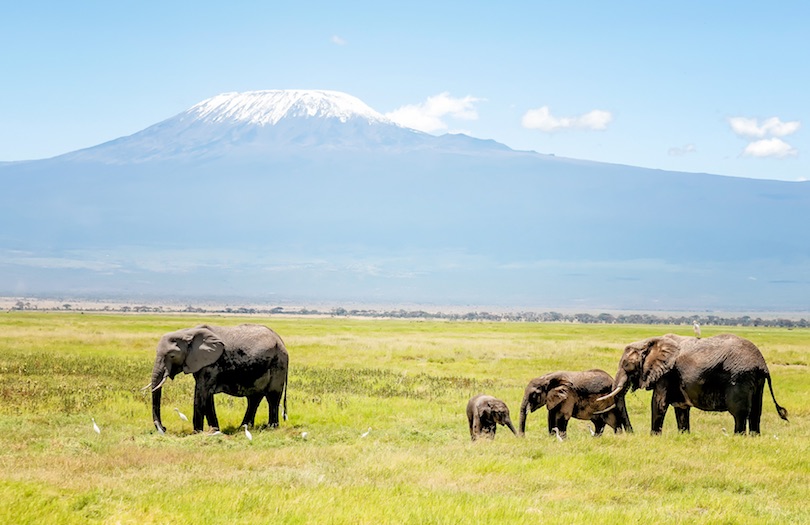
In the dry season from June through October, the Tarangire River becomes the only water source in a vast area and draws elephant herds of extraordinary size. A hundred elephants at a river crossing, with calves struggling up the banks and old matriarchs waiting patiently for the young, is a wildlife experience that sits alongside anything the Serengeti delivers and does it at a fraction of the tourist vehicle density.
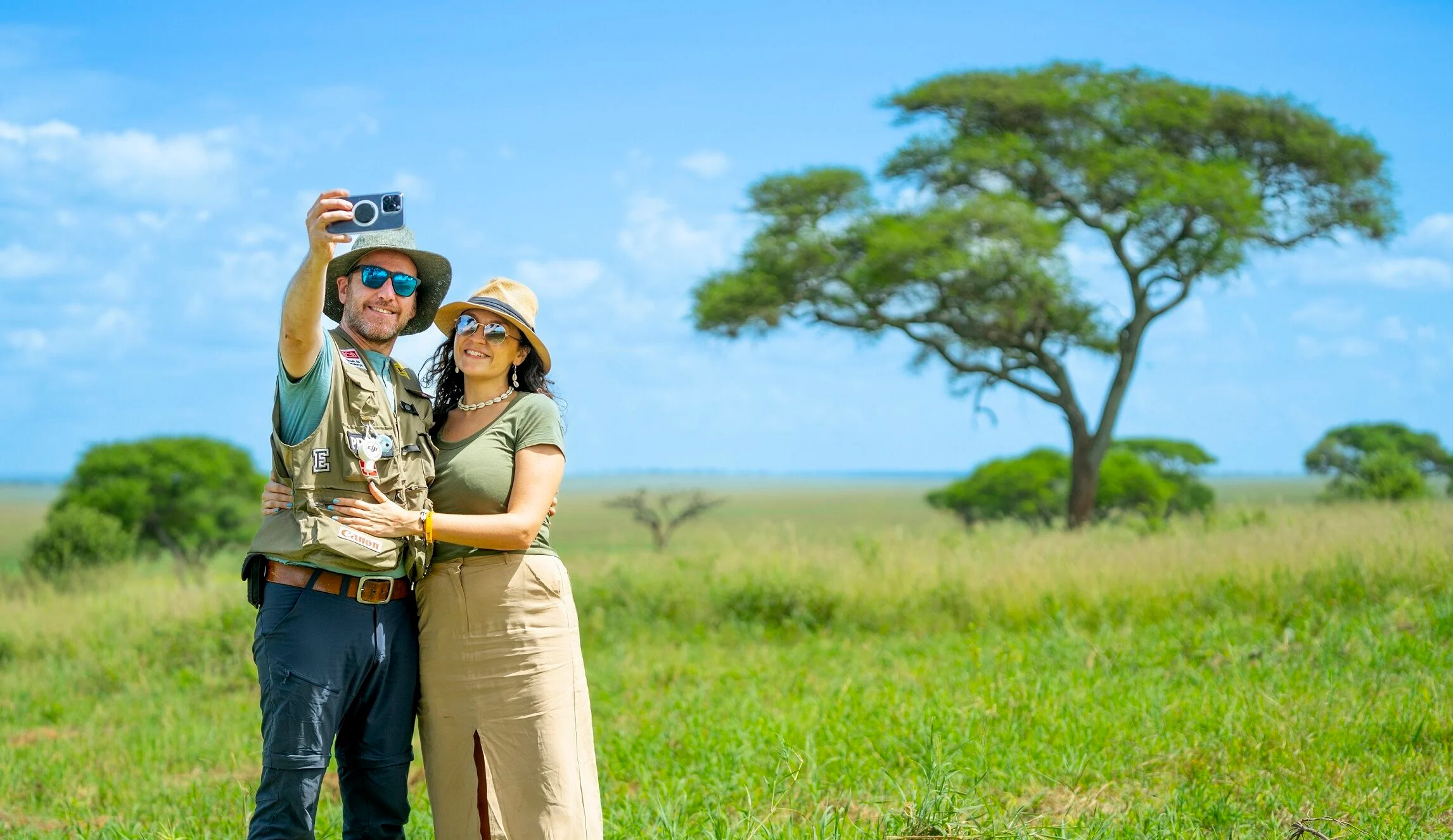
For honeymooners, the tree lodges within Tarangire are the most distinctive and romantic accommodation option in Tanzania’s north. Suites built into the canopy of massive baobabs, where you wake up above the forest floor to the sound of elephants moving through the trees below, are genuinely unlike any other honeymoon accommodation in East Africa.
The Ngorongoro Crater:
The Ngorongoro Crater is formed from a massive volcano that collapsed inward approximately three million years ago, creating a caldera twenty kilometres across and six hundred metres deep that has become a self-contained ecosystem of extraordinary density. Some twenty-five thousand large animals live on the crater floor permanently, including the rare black rhino. The crater is a UNESCO World Heritage Site and one of Africa’s Seven Natural Wonders.
The first view of it arrives at the rim, and nothing a guide says or a guidebook writes prepares you. You drive through highland forest and then the trees thin and the road reaches the edge and suddenly nineteen kilometres of crater is spread below you, misty in the early morning, with the movement of animals visible even at that distance. Most couples go quiet here, and that silence is one of the more honest moments of a Tanzania honeymoon.
The rim lodges are among the most romantically positioned properties in Africa. andBeyond Ngorongoro Crater Lodge, described by design writers as Maasai meets Versailles, features crystal chandeliers, brocade sofas, banana-leaf ceilings, and views directly into the crater that are different at every hour of the day. Ngorongoro Crater Lodge offers a level of theatrical luxury that surprises guests who expected comfortable and got astonishing. For couples who want something more pastoral and less dramatic, Gibb’s Farm on the crater’s western slopes combines stone cottage accommodation, farm-to-table dining from the property’s own gardens, and walking trails through coffee and eucalyptus with a warmth and intimacy that suits a honeymoon perfectly.
The Serengeti:
The Serengeti is about the biggest possible version of everything. The biggest sky. The biggest herds. The biggest predator concentrations. The biggest sunsets. It is a landscape that operates at a scale the human eye was not designed to process, which is why people who have been there more than once still arrive at the Malanja Depression, where the highland road descends into the plain and the Serengeti opens in every direction and feel the same jolt of disorientation that happened the first time.
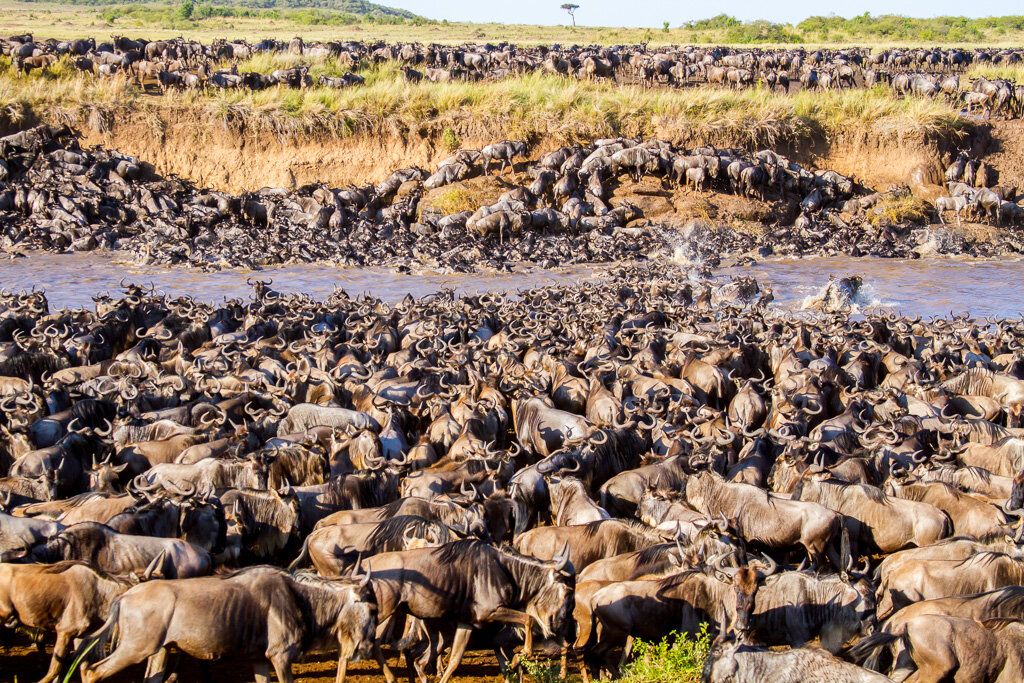
The Great Migration, when over 1.5 million wildebeest travel a clockwise circuit between Tanzania and Kenya following the rains, reaches its most dramatic moment in the Serengeti’s northern sector and the Mara River crossings between July and October. Watching a crossing together, with hundreds of thousands of animals pressing into a crocodile-filled river and the sound of hooves and water filling the air and predators moving on the far bank, is an experience that couples who witness it report as genuinely transformative.
Outside migration season, the Serengeti delivers exceptional predator viewing year-round. The central Seronera region, where the Seronera River system creates year-round water, supports resident lion prides, leopards that lounge in fever trees, and cheetah on the open plains. A January or February honeymoon in the southern Serengeti during calving season, when thousands of wildebeest calves are born over a matter of weeks and the predator-prey drama runs at peak intensity, is one of the finest wildlife experiences available anywhere on earth in those months.
|
Tanzania Honeymoon Circuit |
Key Wildlife |
Best Season |
Romance Factor |
|
Tarangire National Park |
Elephant herds, lions, baobabs |
June to October |
Tree lodges, fewer tourists |
|
Lake Manyara National Park |
Tree-climbing lions, flamingos |
Year-round |
Lakeshore setting, birds |
|
Ngorongoro Crater |
Big Five including rhino |
Year-round |
Rim lodge views, crater sunsets |
|
Northern Serengeti |
Migration river crossings |
July to October |
Raw spectacle, intimate camps |
|
Central Serengeti (Seronera) |
Lions, leopard, cheetah year-round |
Year-round |
Consistent wildlife, mobile camps |
|
Zanzibar Island |
Marine life, Stone Town culture |
June to October, Dec to Jan |
Beach, Indian Ocean sunsets |
The Southern Circuit:
For honeymooners who actively dislike sharing their safari experience with other vehicles, who want the feeling of genuine remoteness rather than managed wilderness, and who are willing to accept slightly lower wildlife density in exchange for privacy that the northern parks cannot provide at peak season, southern Tanzania is the answer.
Nyerere National Park, formerly known as the Selous and the largest game reserve in Africa, and Ruaha National Park together form a southern circuit that sees a tiny fraction of the visitors that the Serengeti receives. In Nyerere, the Rufiji River creates a waterway system that supports exceptional concentrations of hippos, crocodiles, and waterbirds, and the boat safaris available here, drifting silently along the river at dawn while the forest on either side fills with life, offer a romantic dimension to the safari experience that game drives simply cannot replicate
Zanzibar:
There is a specific quality of relief that arrives when you step off the small plane from the mainland onto Zanzibar and the Indian Ocean appears between the palm trees and the air smells of cloves and salt. After days of game drives and early mornings and the extraordinary compression of emotion that comes with watching wildlife at the scale Tanzania delivers, landing on this island feels like the trip has been saving the last movement for last.
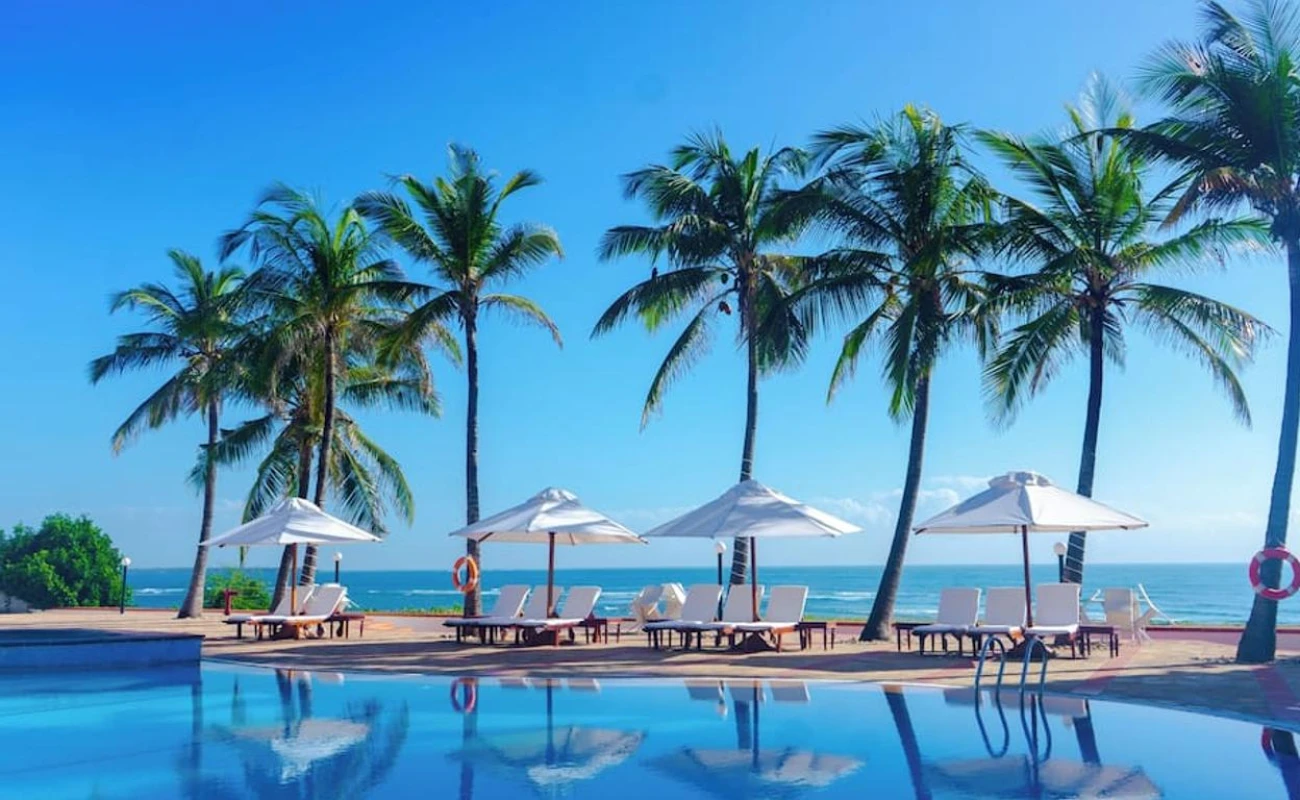
Zanzibar’s north coast at Nungwi and Kendwa offers swimming year-round, protected by the coral reef that runs parallel to the shore, with water temperatures that stay between twenty-four and twenty-eight degrees and a turquoise colour that no photograph accurately captures. The east coast at Paje and Jambiani is calmer, quieter, and more locally textured, with seaweed farms stretching across the tidal flats at low tide and the pace of a village rather than a resort strip.
Stone Town, the island’s historic Swahili capital and a UNESCO World Heritage Site, rewards one full day of exploration before retreating to the beach. The carved wooden doors, the narrow coral stone alleyways, the call to prayer drifting over ancient rooftops, and the Forodhani Gardens night market where locals and visitors share fresh seafood grilled on the spot all provide a cultural depth that makes Zanzibar more than just a beautiful beach and gives the honeymoon ending a human texture.
Mnemba Atoll, a tiny private island accessible only by boat from the northeast coast of Zanzibar, is the most exclusive property in the archipelago and one of the most romantic resorts in the entire Indian Ocean. Twelve bandas with personal attendants, extraordinary snorkeling directly off the beach, and the particular silence of a place that has no cars, no roads, and no other guests beyond the twelve couples who fill it each night make it the kind of place that honeymooners describe years later as simply the most beautiful place they have ever been.
The Romantic Experiences That Define a Tanzania Honeymoon
Hot Air Balloon Safari at Sunrise
A sunrise balloon over the Serengeti rises in darkness, crests into the first light as the plains below shift from shadow to gold, and drifts silently above a landscape that contains more wildlife than the eye can separate. Elephants look like slow-moving boulders. Lion prides are visible from above in their resting circles.
The migration, when present, stretches to the horizon in every direction. One hour in the air ends with a champagne breakfast on the savannah wherever the balloon lands, tables set in the open bush, a toast with a glass of something cold in the middle of the African morning. It costs approximately $600 per person. Every couple who has done it says it was worth every dollar.
Private Bush Dinners
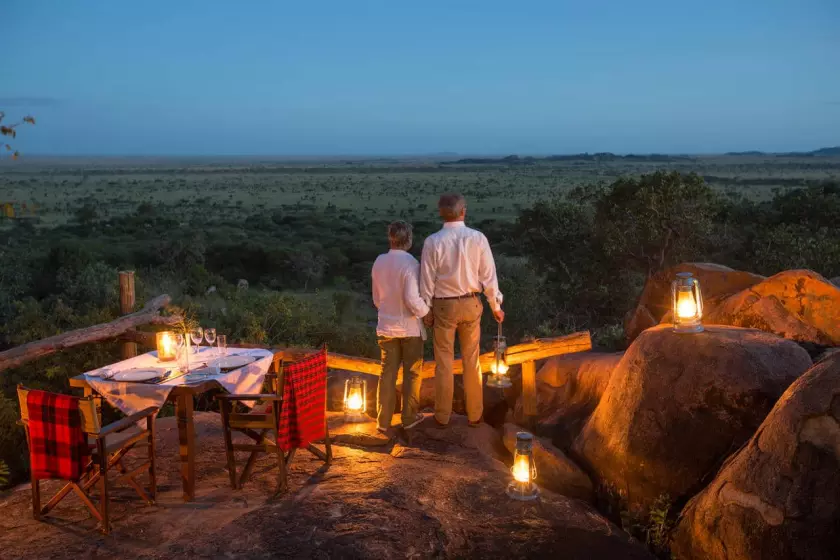
Most luxury lodges in Tanzania can arrange a private dinner in the bush for honeymooners with a few days’ notice. A table set fifty meters from camp in the open savannah, lit by lanterns and a small fire, served by a dedicated waiter while the sounds of the African night move in from every direction, is one of those experiences that works because of context.
The same food served in a dining room would be a good dinner. Served out here, with lions possibly calling at the edge of the darkness and the Milky Way overhead in full clarity, it is a memory.
Sundowners on the Kopjes
The Serengeti’s kopjes, the granite outcrops that rise from the plains and host their own ecosystems of plants and lizards and the occasional leopard, are the ideal sundowner location.
A guide drives to one with cold drinks packed, the vehicle parks at the base, and for an hour you sit on warm rock watching the plains turn from gold to amber to the deep orange of the final minutes before dark.
The horizon at the Serengeti in the last light of the day belongs in a category of beauty that very few landscapes on earth access.
Walking Safaris in the Southern Circuit
Walking safaris are not available in Tanzania’s northern parks due to wildlife density and regulation. They are available in the south, in Ruaha and Nyerere, and they transform the safari from a spectacle into a conversation with the landscape.
On foot with an armed ranger and a tracker, you approach wildlife differently, read signs that a vehicle passes without noticing, and understand the bush at a scale and intimacy that changes how you see even the game drive that follows.
For adventurous honeymoon couples who want their trip to be about more than comfortable observation, a walking safari in the south is the element that sets the experience apart.
When to Go For a Tanzania Honeymoon?
Tanzania is essentially a year-round destination with two key seasonal variables: the migration timing and the weather. For couples who want the Serengeti migration river crossings, July through October is the window, with August and September the peak. For couples who want the calving season with its extraordinary predator-prey drama, January through March in the southern Serengeti is superb. December is excellent in most northern parks and the best month for Zanzibar after the short rains clear.
The long rains in April and May bring significantly lower visitor numbers, dramatic green landscapes, and substantially reduced lodge rates. Couples with flexible dates and a taste for lush scenery and genuine solitude find the long rains period in Tanzania one of the best-kept secrets in East Africa honeymoon travel, as long as they accept that some camps close for maintenance and road access to remote areas becomes more challenging.