10 Best Luxury Safari Camps & Lodges in Serengeti
10 Best Luxury Safari Camps & Lodges in Serengeti; Choosing where to stay in the Serengeti is a different exercise than choosing a hotel almost anywhere else in the world. The ecosystem stretches across nearly 12,000 square miles, and the single biggest variable in your experience — what you actually see outside the vehicle each morning — depends less on how many stars a property carries and more on where it sits and when you arrive.
A world-class camp in the wrong location during the wrong month can mean quiet plains and distant game. A modest tented camp in the right spot during a river crossing week can deliver the single most memorable morning of a traveler’s life.
We’ve built itineraries around every corner of this ecosystem for years, and the question we hear most often from travelers comparing camps is some version of “Will I actually see the migration from here in my travel month? It’s the right question, and a glossy brochure rarely answers it honestly.
This guide walks through ten of the Serengeti’s genuinely exceptional luxury camps and lodges, chosen because together they cover the park’s four functional regions — central Seronera, the north near the Mara River, the western corridor, and the southern short-grass plains around Ndutu area so you can see how camp choice and travel month work together, rather than treating this as a simple best-of ranking.
Every property below is currently operating and represents a distinct style of luxury, from Four Seasons-level polish to raw, rock-set tented camps with nothing but canvas between you and the plains. Some move with the herds. Others stay fixed and let the migration come to them over the course of the year. Neither approach is objectively better — the right choice depends on your travel dates, your priorities, and how many camps you’re willing to combine in one trip.
How Serengeti Geography Shapes the Migration — and Your Camp Choice
The Great Migration isn’t a single event you either catch or miss. It’s a continuous, weather-driven loop of roughly 1.5 million wildebeest and several hundred thousand zebra moving in a rough clockwise circuit through the ecosystem, and where they are on any given week depends on where the rain has recently fallen. Understanding the four regions below removes most of the guesswork before you even start comparing camps.
- Southern Serengeti and Ndutu (December–March): the short-grass plains here are the calving grounds, where over half a million calves are born within a few weeks each year. This is also the best predator viewing window in the ecosystem, since lion, cheetah, and hyena concentrate around the vulnerable newborns.
- Western Corridor (April–July): as the grass is grazed down, the herds push west toward the Grumeti River, where crocodile-filled crossings begin around June and typically continue into July. Crossings here are smaller and less crowded with vehicles than the Mara River equivalent.
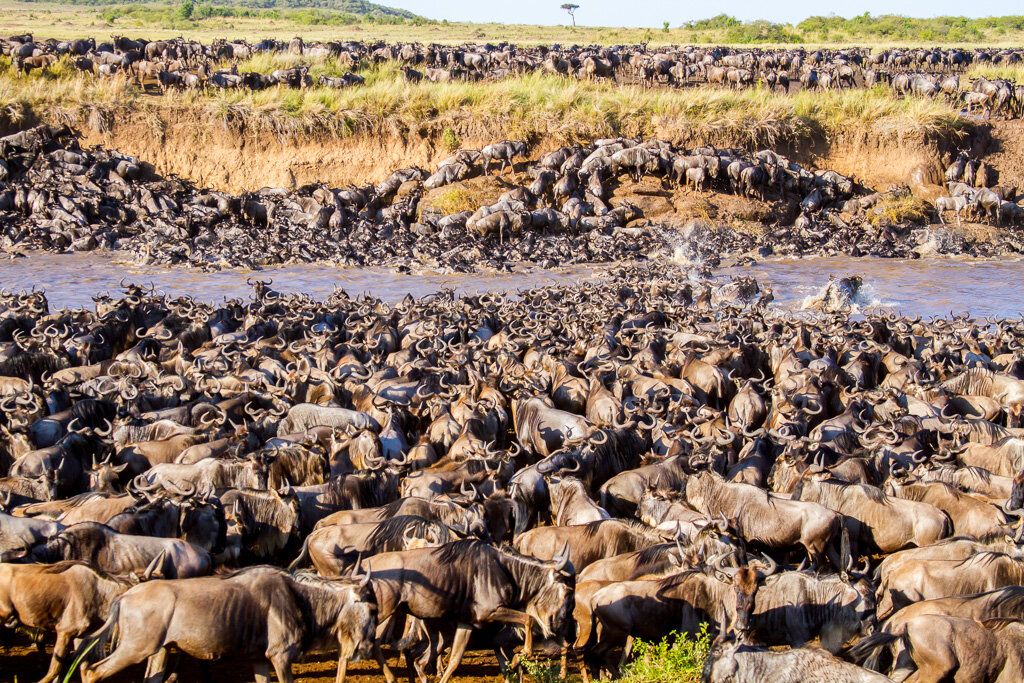
- Northern Serengeti and the Mara River (July–October): this is the migration most people picture — mass river crossings at Kogatende and the Lamai Wedge, with the herds pushing back and forth across the Mara River into Kenya and back through October.
- Central Serengeti, Seronera (year-round): the herds pass through only briefly, in May–June and again in November, but Seronera holds the highest density of resident lion and leopard in the park all year, which makes it a dependable choice regardless of migration timing.
No camp, however well positioned, can guarantee a crossing on a specific day wildebeest read water levels, grass, and predator pressure that no guide can fully predict. What a well-chosen camp does guarantee is that you’re in the region where the action is statistically most likely during your travel dates, with a guiding team that reads the herd’s daily movement better than anyone else in that stretch of the park.
Comparing the Ten Camps at a Glance
Price tiers below reflect approximate per-person, per-night, sharing rates in US dollars during standard (non-peak) season, based on published rack rates; exact quotes vary by month, room category, and current promotions, so treat these as a starting point for budgeting rather than a quote.
| Camp / Lodge | Region | Best Season | Standout Feature | Best For |
| Four Seasons Safari Lodge Serengeti | Central (Seronera) | Year-round | Infinity pool overlooking a natural watering hole | First-timers, families, honeymooners wanting resort comfort |
| Dunia Camp (Asilia) | Central (Seronera) | Year round; strong Dec–Mar & Jun | Just 8 tents, unfenced, off-grid bush setting | Purist travelers, photographers wanting value luxury |
| Namiri Plains (Asilia) | Eastern/Central plains | Year-round (cheetah territory) | Dedicated cheetah conservation area with research access | Serious photographers, repeat safari travelers |
| Sayari Camp (Asilia) | Northern Serengeti, Mara River | Jul–Oct | Closest permanent camp to the Mara River crossings | Migration-chasers wanting a fixed, reliable base |
| Lamai Serengeti (Nomad Tanzania) | Northern Serengeti, Lamai Wedge | Jul–Oct | Built into a rock kopje with two natural rock pools | Honeymooners and families wanting drama with comfort |
| Singita Sasakwa Lodge | Western Corridor, Grumeti Reserve | Year-round; migration Jun–Jul | Colonial-manor luxury on a private 350,000-acre reserve | Travelers wanting the most exclusive, highest-service stay |
| Kirawira Serena Camp | Western Corridor, Grumeti River | Jun–Jul | 25 Edwardian-styled tents, largest western-corridor camp | Groups and classic-safari travelers seeking value |
| Sanctuary Kusini Camp | Southern Serengeti, Ndutu area | Dec–Mar (calving) | Front-row seat to calving season on the short-grass plains | Photographers and predator-action travelers |
| Ubuntu Migration Camp (Asilia) | Mobile — Ndutu, West, North | Year-round, camp relocates 3x | Genuinely follows the herds through three migration phases | Migration purists wanting one camp, one long stay |
| andBeyond Serengeti Under Canvas | Mobile — relocates 5x/year | Year-round | Full-service mobile luxury with butler-level polish | Multi-generational groups wanting flexibility without losing comfort |
The Ten Camps, In Detail
1. Four Seasons Safari Lodge Serengeti — Central Serengeti
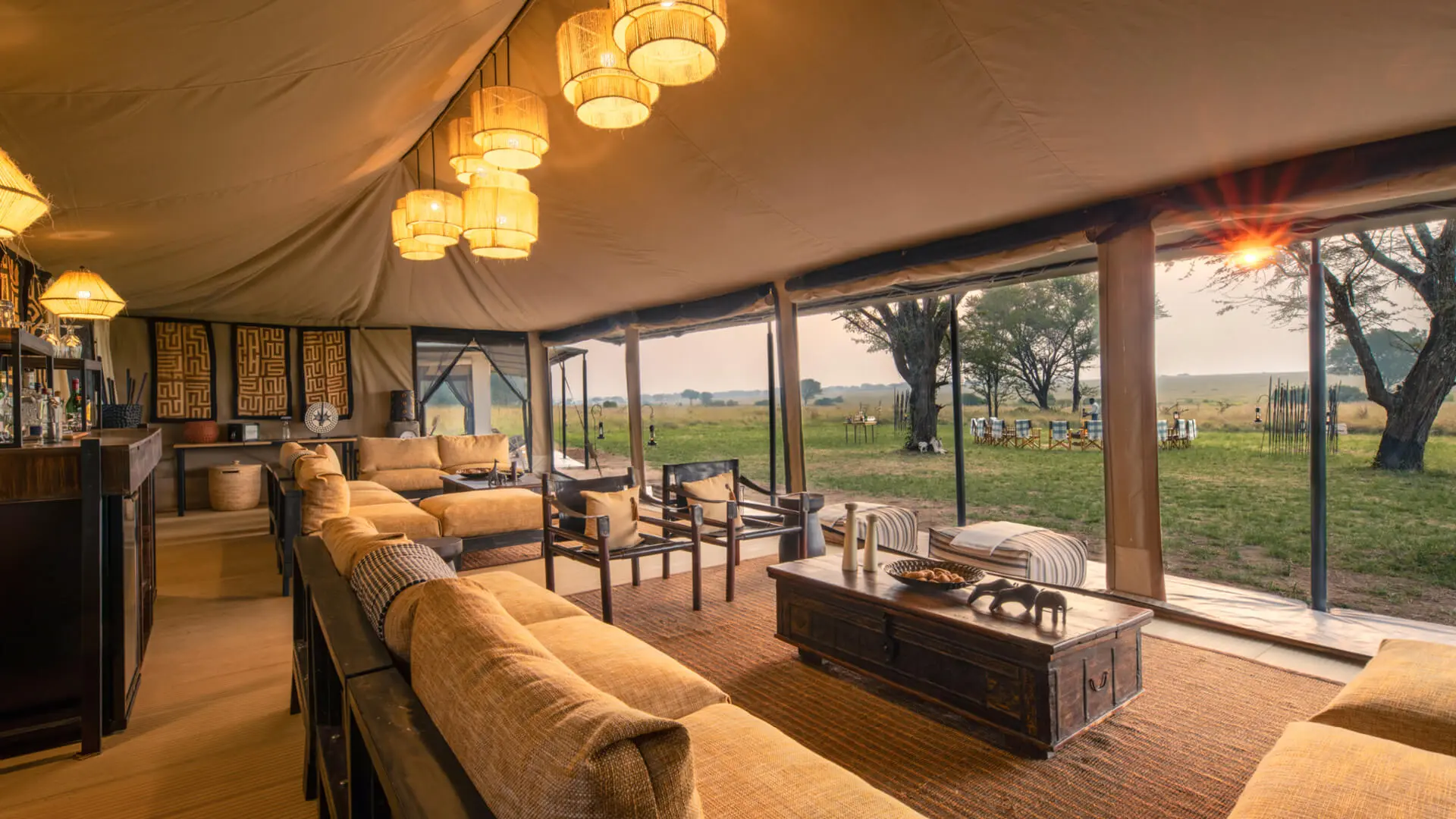
Set on a rise above the Seronera Valley with a watering hole visible from the infinity pool, this is the most resort-like property on this list, and that’s precisely the point for a certain kind of traveler.
The lodge offers more than 70 spacious suites and villas, a full spa, a wine cellar, and a kids’ program that makes it one of the few genuinely comfortable options for families traveling with young children. Because it sits in the ecological heart of the park, resident lion and leopard sightings are dependable across every month, even outside migration season.
The trade-off is scale: this is a bigger property than the intimate 8-to-15-tent camps elsewhere on this list, so it suits travelers who want five-star infrastructure and flexibility over an intensely private bush experience. It’s a strong first camp for anyone new to safari who wants a soft landing before moving to smaller, more remote properties later in a multi-camp itinerary.
2. Dunia Camp — Central Serengeti
Dunia keeps things deliberately small: eight tents, unfenced, set among rock kopjes about 45 minutes from Seronera airstrip, running entirely off solar power. The camp trades some of the polish of larger central lodges for a rawer, closer-to-the-bush feel and a noticeably better guide-to-guest ratio, which shows up in the quality of game drives and the personal attention at meals.
Because Dunia sits in the same resident big-cat territory as Four Seasons, it delivers similarly reliable year-round game viewing at a meaningfully lower price point. This is the camp we recommend most often to photographers and repeat safari travelers who have already done the big lodge experience and want something more intimate without needing peak migration timing to justify the trip.
3. Namiri Plains — Eastern/Central Plains
Namiri sits on the eastern plains in an area that was closed to tourism for two decades to allow the local cheetah population to recover undisturbed, and it remains one of the best places in East Africa to see cheetah behavior up close, including active research collaborations guests can join. The ten stone-and-canvas tents are built to blend into the rock outcrops around them, with sliding glass fronts that keep the plains constantly in view.
This camp rewards travelers who have already ticked off the standard big-five checklist elsewhere and now want depth rather than breadth fewer species, watched more closely, with guides who know individual cheetah coalitions by name. It’s less suited to first-time visitors chasing a broad wildlife list in a short stay.
4. Sayari Camp — Northern Serengeti
Sayari is the closest permanent camp to the Mara River, split into two wings of nine and six tents so that no more than fifteen rooms share the same dining area at once. Each tent has a private veranda and a bath positioned to look straight out over the plains.
Between July and October, this proximity translates into a genuine advantage: shorter drive times to crossing points mean more flexibility to wait out a slow morning or reposition quickly when word comes through on the radio that wildebeest are massing at the river.
Outside the July–October window, the northern Serengeti empties out considerably, and Sayari becomes a quieter, more exclusive base for resident game rather than a migration-focused stay. Book this camp specifically for crossing season; it’s not the most efficient choice for a December or April trip.
5. Lamai Serengeti — Northern Serengeti, Lamai Wedge
Built into the Kogakuria kopje on the northern bank of the Mara River, Lamai looks directly across the water toward Kenya’s Masai Mara, with two natural rock swimming pools carved into the granite. Nomad Tanzania splits the twelve tents between a Main Camp and a smaller Private Camp, which gives families or small groups the option to book the whole private side for added seclusion.
Compared with Sayari, Lamai leans slightly more toward comfort and romance than raw proximity to the river, which makes it a favorite for honeymooners who still want a realistic shot at crossing season without sacrificing intimacy. Families traveling with older children also do well here, given the camp’s flexibility around private-camp bookings.
6. Singita Sasakwa Lodge — Western Corridor, Grumeti Reserve
Sasakwa sits on a private 350,000-acre reserve bordering the national park, styled as an Edwardian manor house complete with a croquet lawn, tennis court, stables, and infinity pools looking out over the plains below. This is the highest tier of luxury on this list, with a staff-to-guest ratio and level of finish that few properties anywhere in Africa match, and rates to match that positioning.
Because Sasakwa controls access to its own private reserve in addition to Serengeti National Park itself, game drives here aren’t bound by the same vehicle-density rules that apply inside the park, which matters during peak migration weeks when public areas get crowded. It suits travelers for whom the accommodation and service are as much the point of the trip as the wildlife, including honeymooners and milestone-anniversary travelers with a generous budget.
7. Kirawira Serena Camp — Western Corridor
Kirawira sits on a hilltop above the Grumeti River with twenty-five tents finished in Edwardian style steamer trunks, brass fittings, four-poster beds making it the largest camp on this list and one of the more accessible price points for the western corridor. June and July bring Grumeti River crossings within reach, smaller and less crowded with vehicles than their Mara River counterparts but dramatic in their own right, crocodiles included.
The larger tent count means Kirawira suits groups and multi-generational families better than the more intimate 8-to-12-tent camps elsewhere on this list, without asking guests to give up genuine colonial-safari atmosphere. It’s a sensible anchor for a western-corridor stay for travelers balancing budget against comfort.
8. Sanctuary Kusini Camp — Southern Serengeti, Ndutu Area
Kusini’s twelve tents are scattered around a rocky kopje on the southern plains, positioned for exactly one purpose: front-row access to calving season between December and March, when the concentration of wildebeest and the predators following them reaches its highest density anywhere in the ecosystem.
Newborn calves stand and walk within minutes of birth, which draws lion, cheetah, and hyena into close, near-constant activity across the plains around camp.
This is the camp we point photographers toward more than any other on this list, since predator interactions here are frequent and the light on the open plains is exceptional. It’s a poor match for travelers whose dates fall outside the December–March window, since the plains empty out considerably once the herds move on.
9. Ubuntu Migration Camp — Mobile, Ndutu / Western Corridor / Northern Serengeti
Ubuntu is a genuine mobile camp, not just a marketing label: it relocates roughly three times a year to stay ahead of the herd, sitting in Ndutu from December through March, the western corridor from May to mid-July, and the northern Serengeti from late July through November. Eight tents keep the experience intimate, with a simpler, more traditional canvas-and-camp-bed setup than the fixed luxury lodges elsewhere on this list.
This camp suits travelers who want to commit to one long stay and let the camp do the work of tracking the migration, rather than switching between multiple fixed properties themselves. It won’t appeal to guests who want lodge-level infrastructure like large pools or spa facilities, since the trade-off for genuine mobility is a lighter physical footprint.
10. andBeyond Serengeti Under Canvas — Mobile, Relocates Five Times a Year
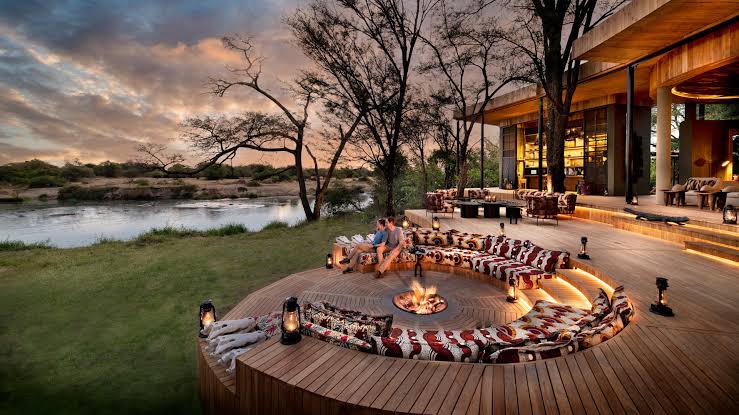
&Beyond runs two nine-tent camps that move a combined five times annually, chasing the migration’s calving, crossing, and transitional phases while maintaining a noticeably higher service level than most mobile operations en-suite bucket showers, a full mobile kitchen turning out plated dinners, and butler-style service at each site. The nearest airstrip shifts with the camp’s location, cycling through Seronera, Ndutu, Grumeti, or Kogatende depending on the season.
This is the camp for travelers who want the romance and authenticity of a mobile safari without stepping down in comfort from a fixed luxury lodge. It’s particularly well suited to multi-generational groups who want one seamless booking that tracks the migration automatically, rather than coordinating transfers between several separate camps themselves.
Planning Your Serengeti Camp Stay:
When to book
Camps in the northern Serengeti for July–October crossings and in Ndutu for December–March calving season carry the tightest inventory in the ecosystem, and the best tent categories at properties like Sayari, Lamai, and Sanctuary Kusini can sell out nine to twelve months ahead for the most popular weeks.
Western corridor camps for June–July have somewhat more flexibility, and central Seronera properties like Four Seasons and Dunia are the easiest to book on shorter notice since they deliver solid game viewing in any month.
How many camps to combine
Most travelers spending a dedicated Serengeti trip do best combining two to three camps across different regions over seven to ten nights, rather than staying in one place the whole time.
A common, well-balanced pattern is three nights in the region matching the current migration phase, followed by two to three nights in central Seronera for dependable big-cat viewing regardless of where the herds happen to be. Trips shorter than five nights are better served by picking one region and committing to it rather than spreading thin across multiple transfers.
Fly-in versus road transfer
Most Serengeti itineraries fly in on light aircraft from Arusha or Kilimanjaro, connecting to the appropriate regional airstrip near each camp; this is close to essential for northern camps like Sayari and Lamai, given the distances involved.
Road transfers between regions, such as Ndutu to the western corridor or Seronera to the north, are possible and cost less, but can mean five to six hours on rough tracks. We generally recommend flying between regions and reserving road time for shorter transfers within a single area, where the game viewing along the way adds real value rather than just adding hours in a vehicle.
Malaria and health basics
The Serengeti carries a low-to-moderate malaria risk that varies by season, generally lower during the dry months of June through October and higher during and after the rains. Antimalarial prophylaxis is still advisable regardless of season, alongside standard precautions like repellent and covered clothing in the evenings; every camp on this list supplies mosquito nets as standard.
Travelers arriving from a yellow fever endemic country should carry proof of vaccination, and a visit to a travel health clinic six to eight weeks before departure is worth the time for anyone with underlying health considerations.
Recommendations by Traveler Type
- Honeymooners: Lamai Serengeti for northern drama with romance, or Singita Sasakwa for the highest tier of privacy and service.
- Families with children: Four Seasons Safari Lodge Serengeti for its kids’ program and space, or Lamai Serengeti’s Private Camp for a self-contained family base.
- Serious photographers: Namiri Plains for cheetah behavior, Sanctuary Kusini during calving season, or Sayari Camp during peak crossing weeks.
- Migration purists and repeat safari travelers: Ubuntu Migration Camp for an authentic, budget-conscious mobile experience, or andBeyond Serengeti Under Canvas for the same idea with more polish.
- Budget-conscious luxury travelers: Dunia Camp, Kirawira Serena Camp, or Sanctuary Kusini all deliver genuine luxury well below the ecosystem’s top price tier.
- Multi-generational groups: Kirawira Serena Camp’s larger tent count and Four Seasons’ villa configurations both handle bigger parties comfortably.
- First-time safari travelers: Four Seasons Safari Lodge Serengeti offers the most forgiving, full-service introduction to the region.